If your digital channels disagree, which version becomes the truth?


An organisation’s digital footprint is now interpreted by people, search engines, AI assistants and automated data platforms. Maintaining authority requires more than a consistent corporate website. It requires a governed narrative, Brand Identity and factual foundation across the channels and systems audiences encounter.
An investor visits your corporate website. A candidate moves from LinkedIn to a careers microsite and then into an application platform. A journalist checks a regional site before asking an AI assistant for a summary. Meanwhile, automated systems gather public information about your leadership, financial performance and sustainability.
They are all looking at the same organisation. They are rarely meeting the same version of it.
This is not a theoretical concern or a minor issue of consistency. It is a reputational and governance problem, and one we are seeing more often. Across recent reviews of multinational businesses, we have found profiles of former board members still live across digital estates, superseded ESG data resurfacing in AI-generated research, and competing descriptions of the same organisation across websites, social channels and search results. Each version appeared credible in isolation. No single team had visibility of the fractured narrative they created together.
The organisation manages channels. The audience experiences a footprint
The cause usually sits inside the organisation. Communications owns the corporate website. Investor Relations owns results and reporting. Sustainability manages ESG disclosures. HR runs the careers experience. Marketing manages social channels and campaigns. Regional teams maintain local sites, often with different agencies, systems and publishing processes.
These boundaries make sense internally. Audiences, and the machines summarising on their behalf, cannot see them.
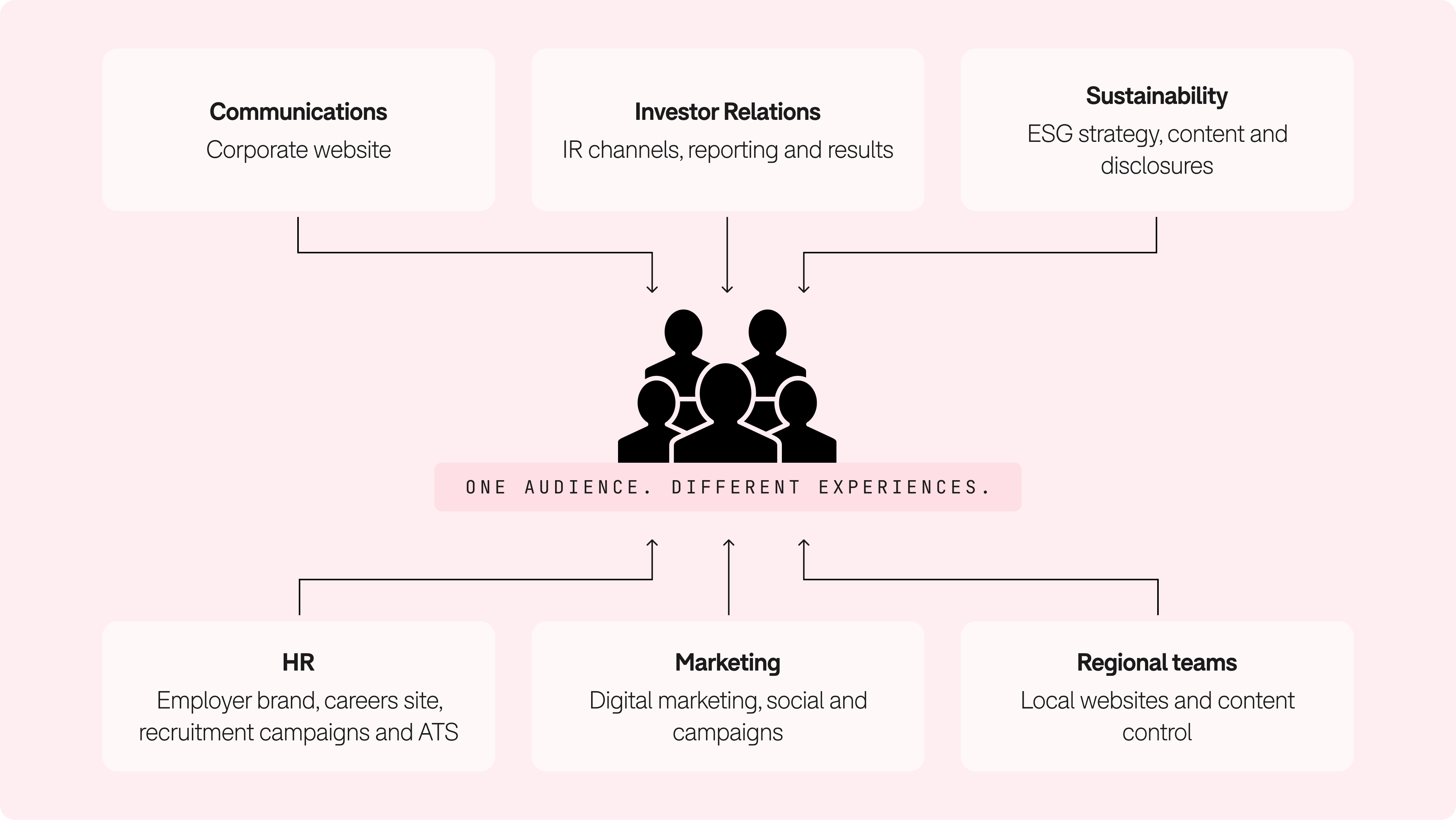
A candidate does not distinguish between an employer-brand campaign and the applicant tracking system it leads into. An investor does not care that a regional site sits outside the corporate team’s publishing workflow. A journalist will not know that an old executive biography remains live because it belongs to a previous platform. Each interaction contributes to an impression of one organisation.
This is why a channel-by-channel view can be misleading. Every team may be managing its own asset competently while the combined experience remains inconsistent. The organisation manages channels. The audience experiences a footprint.
The changing search environment makes that fragmentation harder to contain. SparkToro’s analysis of Similarweb data found that 68% of US Google searches in the first four months of 2026 ended without a click. AI Overviews are a likely contributor, although the study did not isolate their effect. Increasingly, audiences receive an answer before reaching the organisation’s own source, if they reach it at all.
When inconsistency becomes a reputational risk
Not every difference is a problem. A careers page should not read like an annual report, and an investor journey should not behave like a recruitment campaign. The risk appears when appropriate variation becomes contradiction.
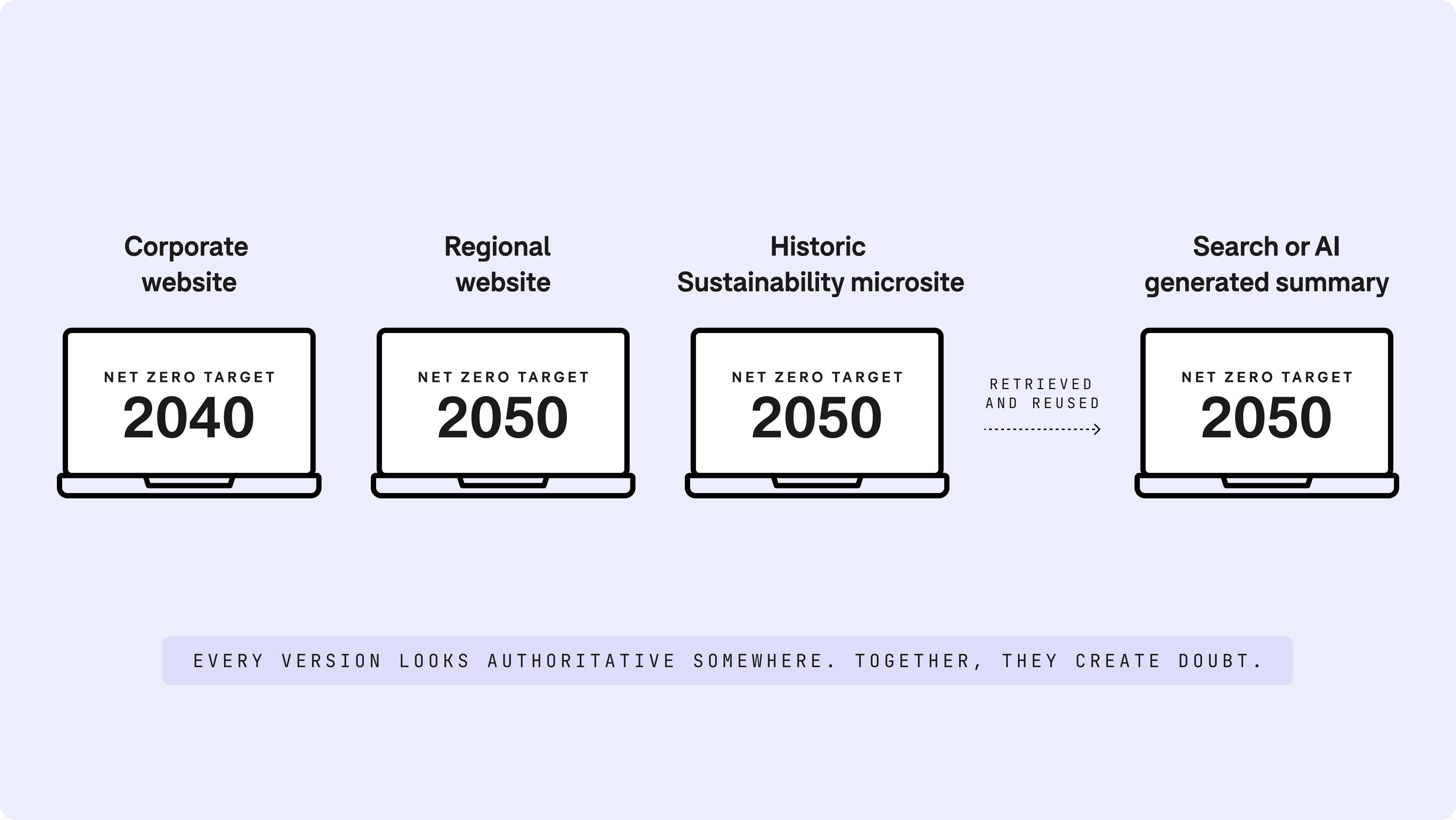
A current corporate narrative sits beside language from a previous strategy. An expressive careers campaign leads into an application system that looks and sounds unrelated. A rebrand transforms the corporate website while regional sites retain the old visual language. New financial results are published, but previous figures continue to surface without a clear reporting period. A sustainability target changes, while an archived PDF or disconnected microsite continues to present the old commitment as current.
These are not only communications issues. Leadership information, financial data and sustainability metrics are gathered and reused by systems outside the organisation’s direct control. ESG data providers describe methodologies that draw on company disclosures, regulatory filings, corporate websites and other public information. Search engines and AI assistants retrieve from similarly broad source sets. Once inaccurate or superseded information is discoverable, it can travel into research, ratings, summaries and decisions.
AI compounds the problem because it can blend a current leadership page, an old PDF and a third-party profile into one response that sounds settled and authoritative. It cannot understand the organisation’s internal hierarchy of sources unless that authority is made visible through current, coherent and well-structured information.
The result is an uncomfortable shift. Organisations are no longer only publishing information for people who will inspect the original source. They are publishing into an environment where intermediaries interpret, extract and redistribute what they find.
Consistency should create recognition, not sameness
The wrong response is to force every channel into identical copy and design. Different audiences need different emphasis, language and journeys. A candidate may need employee stories, culture and progression. An investor needs strategy, governance and performance. A journalist needs a clear corporate summary, leadership information, reports and media assets.
Consistency means that these experiences draw on the same underlying organisation: the same proposition, corporate narrative, Brand Identity and current facts. It allows difference without drift.
Visual expression matters here as much as content. The move from LinkedIn to a careers site and then into an application platform should not feel like passing between unrelated businesses. Visual Identity, imagery, brand visual language, motion and Tone of Voice do not need to be rigidly uniform, but they should create recognition and confidence. A coherent digital Brand Identity tells the user that the organisation has maintained care and ownership across the journey.
Design systems are therefore governance tools, not simply component libraries. They maintain recognition across platforms while allowing teams to meet different audience needs.
The corporate website must establish authority
The corporate website remains the most important controlled expression of the organisation. It should explain what the business is, how it is structured, what it is trying to achieve and why it matters. It should provide the current leadership, governance, performance and sustainability information against which other descriptions can be checked.
But calling it the corporate website does not automatically make it authoritative. Authority has to be demonstrated through accuracy, clarity, findability and maintenance.
A current fact hidden deep in the site may lose to an outdated claim that is easier to retrieve. New role terminology may fail to displace old executive biographies. Revised sustainability commitments remain ambiguous when historic reports and current targets are not clearly dated and connected.
The website therefore has to be both the easiest source to find and the hardest to contradict. It cannot achieve either while the channels around it continue to tell a different story.
Govern the source, not the copies
This is as much a question of architecture as of editorial discipline. When content is structured and systems are connected, a fact can be updated at source and reused wherever the organisation controls its publication. The leadership team, headline results, office locations or net zero target become governed information rather than text recreated independently on multiple pages.
Publishing then becomes a matter of governing a source rather than chasing copies.
We have seen this on corporate platforms. Structured content lets editors tell stories without the facts beneath them drifting. Taxonomy connects audience journeys. Permissions and workflows make ownership visible. CMS back-office tools can bring editorial guidance, style rules and review stages into authoring, helping teams apply standards as content is created. Design systems maintain brand coherence, while integrations connect the corporate website, careers experience and wider digital ecosystem.
Technology does not remove the need for editorial judgement. It creates the conditions in which that judgement can be applied consistently. A platform will only remain authoritative if owners, review cycles and rules for superseding or retiring information are defined.
PDFs and archives require particular attention. They often contain information that was accurate when published and remains important as a historic record. The answer is not to delete the past. It is to give people and machines enough context to distinguish historic disclosure from current corporate reality.
Audit the footprint, not only the website
Many organisations begin a website programme by reviewing the website. That is understandable, but increasingly insufficient. A meaningful review should follow the organisation as an audience experiences it and examine the information flows behind that experience.
It should ask:
What do priority audiences encounter? Trace realistic journeys across search, social platforms, corporate and regional sites, careers content, application systems, reports and third-party profiles.
Which information is authoritative? Identify the source owner for leadership, governance, financial, sustainability, location and corporate-profile information.
Where is information duplicated? Map pages, PDFs, microsites and systems that recreate the same facts, and test what happens when those facts change.
Where does the Brand Identity fracture? Review visual language, Tone of Voice, brand application and transitions between platforms, not only the quality of each asset in isolation.
How is information interpreted externally? Examine search results, AI-generated answers and relevant data platforms for outdated facts, ambiguous terminology and competing descriptions.
Who maintains authority after launch? Define ownership, review cycles, workflows, expiry rules, escalation routes and measures of ongoing quality.
The purpose is to identify where fragmentation creates risk, where shared foundations improve efficiency and where audience trust is being asked to bridge gaps the organisation should resolve.
Authority has to be maintained
The growth of platforms, the breadth of the technology stack and the rapid adoption of AI are changing how organisations are understood. More people and systems now form conclusions without following the journey communications teams expected them to take.
Organisations cannot control every external summary, rating or AI-generated answer. They can reduce the ambiguity those systems encounter. They can make current facts easier to find, historic information easier to interpret and different audience experiences recognisably part of the same organisation.
If this problem feels familiar, passive observation is no longer enough. Corporate authority must be designed into the digital footprint and maintained after launch.
So which version becomes the truth? Whichever is easiest to find, easiest to reuse and hardest to contradict.
A useful first step is to put the same question about your organisation to a few different AI assistants, such as ChatGPT, Gemini, Copilot and Perplexity, then compare their answers with each other and with your corporate site. If they don’t agree, we can help you close the gap. Get in touch.